

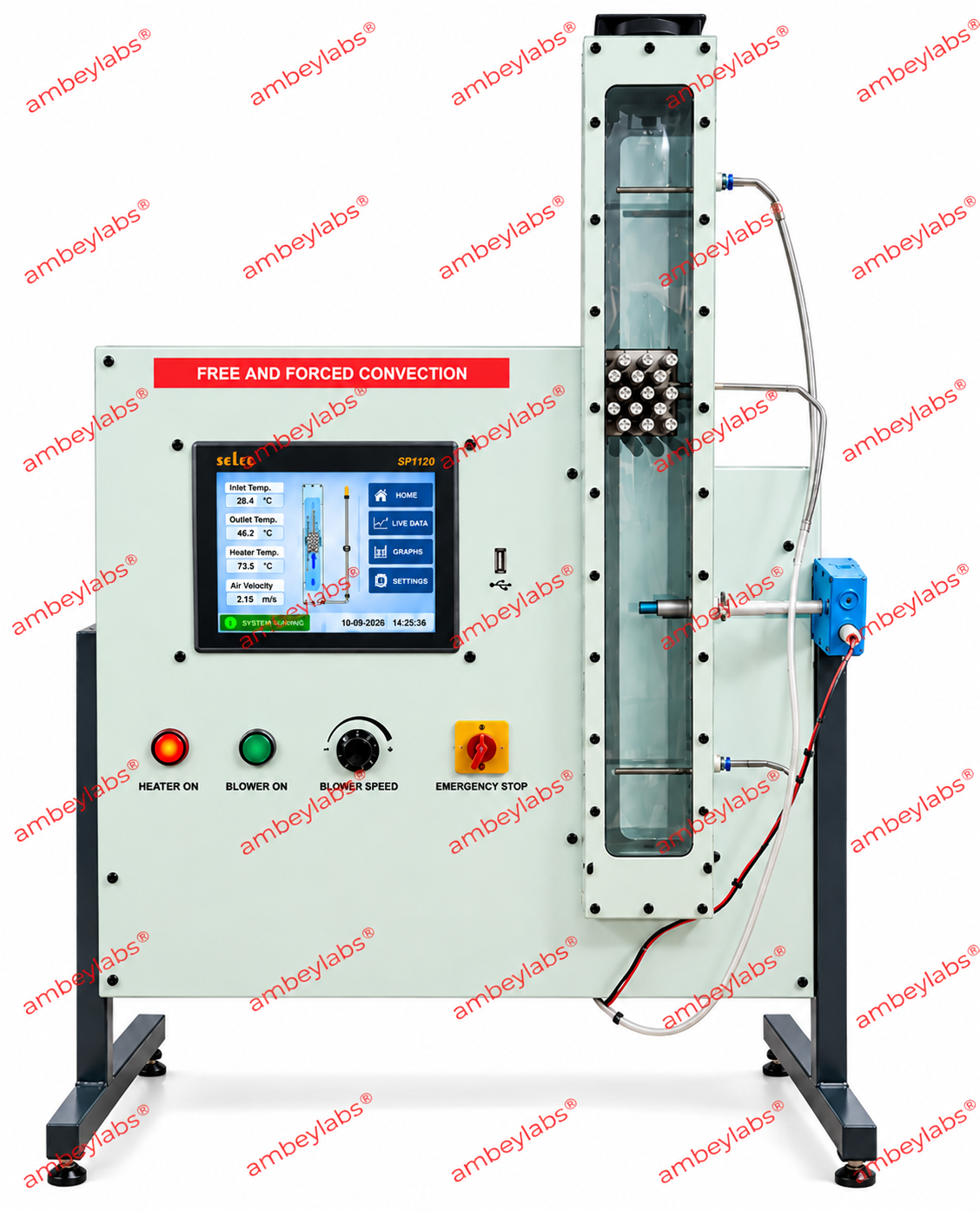
AL-E1168 FREE AND FORCED CONVECTION APPARATUS
Project Information
- Category: MECHANICAL ENGINEERING
- Sub Category: HEAT TRANSFER LAB
- Model Number: AL-E1168
Description
AL-E1168 FREE AND FORCED CONVECTION APPARATUS
Product Description
The AL-E1168 Free and Forced Convection Apparatus is a
compact laboratory training system designed for experimental investigation of free and forced convection heat transfer. The unit
consists of a vertical air duct with interchangeable heating elements and an
axial fan for controlled forced airflow.
Different
heating-element geometries can be selected to study heat transfer
characteristics around a flat plate,
cylinder and tube bundle. Two of the heating elements can also
be operated outside the air duct for free-convection studies.
The apparatus
incorporates temperature measurement at the air-duct inlet and outlet and
air-velocity measurement for determining airflow conditions. Heating power and
airflow can be adjusted and monitored through the supplied software. The system
can be connected to a PC through USB for data acquisition, visualization and
analysis.
1. Main Features
- Compact vertical air-duct
construction.
- Suitable for free and forced convection
experiments.
- Interchangeable heating elements
with different geometries.
- Axial fan for forced-air
circulation.
- Temperature measurement at
air-duct inlet and outlet.
- Air-velocity measurement for
determining airflow rate.
- Adjustable heating power.
- Software-based monitoring and
data acquisition.
- USB interface for PC connection.
- Real-time display and analysis of
experimental parameters.
- Suitable for determination of Nusselt and Reynolds numbers.
- Designed for studying transient
heating characteristics.
2. Technical Specifications
|
Parameter |
Specification |
|
Model |
AL-E1168 |
|
Equipment Name |
Free and Forced Convection Apparatus |
|
Application |
Heat Transfer / Convection Studies |
|
Air Duct Type |
Vertical air duct |
|
Air Duct Flow
Cross-Section |
120 × 120 mm |
|
Air Duct Height |
600–800 mm |
|
Heating Elements |
4 interchangeable geometries |
|
Heating Element
Temperature Limitation |
90°C |
|
Tube Bundle |
23 tubes |
|
Variable Heated
Tube |
1 tube in variable position |
|
Tube Heating Power |
20–50 W |
|
Tube Surface Area |
31.41 cm² |
|
Cylinder Heating
Element |
Uniform surface temperature |
|
Cylinder Heating
Power |
20–50 W |
|
Cylinder Surface
Area |
111 cm² |
|
Cylinder with
Heating Foil |
Provided |
|
Heating Foil Power |
40–60 W |
|
Heating Foil
Surface Area |
111 cm² |
|
Axial Fan |
Provided |
|
Maximum Fan Flow
Rate |
500 m³/h |
|
Power Consumption |
100–200 W |
|
Air Velocity
Measurement Range |
0–10 m/s |
|
Temperature
Measurement |
4 × temperature channels |
|
Temperature Range |
0–400°C* |
|
Heating Power
Measurement Range |
0–100 W |
|
PC Interface |
USB |
|
Software |
Supplied for monitoring and analysis |
*The supplied
specification states “0–4000°C”; for this type of laboratory apparatus, the
intended range appears to be 0–400°C
and should be confirmed against the manufacturer's final datasheet.
3. Heating Elements
The apparatus
shall provide four interchangeable heating configurations for studying
different heat-transfer geometries.
A. Tube Bundle
- Number of tubes: 23
- One tube can be heated in a
variable position.
- Heating power: 20–50 W
- Surface area: 31.41 cm²
B. Cylinder
- Designed to provide approximately
uniform surface temperature.
- Heating power: 20–50 W
- Surface area: 111 cm²
C. Cylinder with Heating Foil
- Heating power: 40–60 W
- Surface area: 111 cm²
D. Additional Geometry / Heating
Element
The fourth
interchangeable heating configuration shall be provided as part of the supplied
experimental set for comparative convection studies.
4. Airflow System
The system
shall incorporate an axial fan
positioned at the top of the vertical air duct.
- Maximum airflow: 500 m³/h
- Ambient air is drawn into the
duct by the fan.
- Air
passes over the selected heating element.
- Heated air exits through the
upper air path.
- Air velocity is measured for
determination of flow conditions.
5. Measurement & Instrumentation
The apparatus
shall provide measurement of:
Temperature
Temperature
sensors shall be provided at the inlet and
outlet of the air duct.
The
measurement system shall support multiple temperature channels for monitoring
the heating elements and air temperature.
Air Velocity
- Measurement range: 0–10 m/s
- Used for determining airflow
conditions and analysing forced-convection experiments.
Heating Power
- Measurement/control range: 0–100 W
- Heating power can be adjusted and
monitored through the software.
6. PC-Based Software
The apparatus
shall be connectable to a PC through USB.
The supplied
software shall provide:
- Real-time measurement display.
- Heating-power monitoring.
- Airflow/air-velocity monitoring.
- Temperature monitoring.
- Recording of experimental data.
- Graphical presentation of
measured parameters.
- Analysis
of experimental results.
- Investigation of theoretical
heat-transfer principles.
- Support for calculation and
evaluation of characteristic heat-transfer parameters.
7. Experiments
The AL-E1168
shall be suitable for performing the following experiments:
Free & Forced Convection
- Study of free/natural convection.
- Study of forced convection.
- Comparison between free and
forced convection.
- Effect of airflow on
heat-transfer characteristics.
Heat Transfer with Different
Geometries
Investigation
of convective heat transfer for:
- Flat plate
- Cylinder
- Tube bundle
Nusselt Number
- Experimental determination of the
Nusselt number.
- Comparison of experimental and
theoretical heat-transfer behaviour.
Reynolds Number
- Calculation of the Reynolds number.
- Investigation of the influence of
airflow conditions on heat transfer.
Characteristic Heat-Transfer
Variables
Determination
and analysis of typical variables associated with convection heat transfer.
Flow & Heat Transfer
Relationship
Investigation
of the relationship between:
- Airflow formation
- Air velocity
- Heating power
- Surface temperature
- Heat-transfer rate
Transient Heating
- Study of the transient heating
process.
- Observation of temperature
variation with time.
- Analysis of the heating curve.
8. Educational Applications
The apparatus
is suitable for laboratory training in:
- Heat Transfer
- Thermal Engineering
- Mechanical Engineering
- Chemical Engineering
- Process Engineering
- Energy Engineering
- Thermodynamics
- Fluid Mechanics
- Engineering Measurements
9. Scope of Supply
The complete
system shall include:
- Vertical air duct assembly.
- Axial fan.
- Interchangeable heating elements.
- Tube-bundle heating assembly.
- Cylinder heating assembly.
- Cylinder
with heating-foil assembly.
- Temperature sensors.
- Air-velocity measurement system.
- Heating-power control/measurement
system.
- USB PC interface.
- Data-acquisition and analysis
software.
- Necessary electrical and
connection accessories.
- User/operating documentation.
- Practical experiment manual.