
AL-E1409 DIDACTIC UNIT FOR VARIABLE SPEED DRIVE (VSD)
Project Information
- Category: ELECTRICAL ENGINEERING
- Sub Category: ELECTRICAL ENGINEERING
- Model Number: AL-E1409
Description
AL-E1409 DIDACTIC UNIT FOR VARIABLE SPEED DRIVE (VSD)
Reference: AL-E1409
·
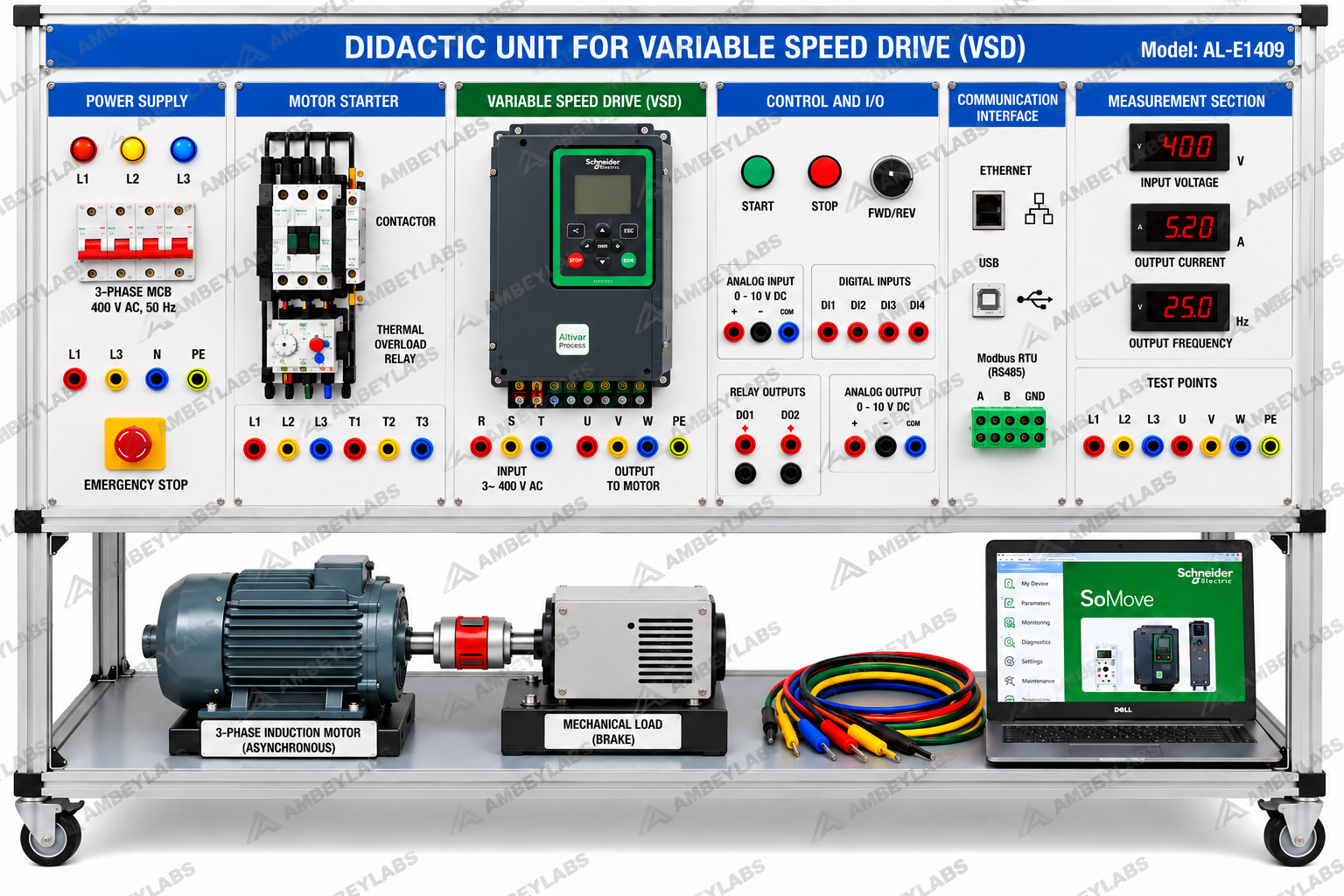
Equipment: Didactic Variable Speed Drive (VSD) training unit for practical
study of asynchronous motor control.
·
Motor Starter: Industrial motor starter suitable for starting and controlling a
three-phase asynchronous motor.
·
VSD: Electronic variable-speed controller with configurable operating
parameters for motor speed control.
·
Motor Control: Start/stop, speed adjustment, direction control and
acceleration/deceleration configuration.
·
Controller Configuration: Provision for programming and
configuring VSD operating parameters.
·
Software: Compatible with Schneider SoMove software for VSD configuration,
parameter setting, monitoring and diagnostics.
·
Communication: Industrial Ethernet communication interface for
controller/drive configuration and networking exercises.
·
Training Applications: Motor starting, VSD parameter
configuration, speed control, fault/diagnostic monitoring and industrial
communication.
·
Motor Interface: Clearly identified terminals for three-phase motor and control
connections.
·
Safety: Suitable electrical protection, emergency stop/fault indication
and safe-access terminals for laboratory training.
·
Accessories: Communication cables, programming/configuration accessories and
required motor connection accessories.
·
Documentation: User manual, experiment manual, wiring diagrams, communication
details and VSD programming/configuration guide.
·
Supplier shall confirm: Exact manufacturer/model,
catalogue or custom-built status, point-by-point compliance, complete BOM and
accessories, dimensions, weight, utilities, interfaces, drawings, safety
certificates, capacity/test evidence, delivery and site-support schedule,
assumptions and exclusions.