
AL-E187E LEVEL / FLOW / PRESSURE / TEMPERATURE CONTROL BENCH WITH CASCADE
Project Information
- Category: MECHANICAL ENGINEERING
- Sub Category: PROCESS CONTROL TRAINER
- Model Number: AL-E187E
Description
AL-E187E
LEVEL / FLOW / PRESSURE / TEMPERATURE CONTROL BENCH WITH CASCADE
AL-E187E LEVEL / FLOW / PRESSURE
/ TEMPERATURE CONTROL BENCH WITH CASCADE
1. Product Description
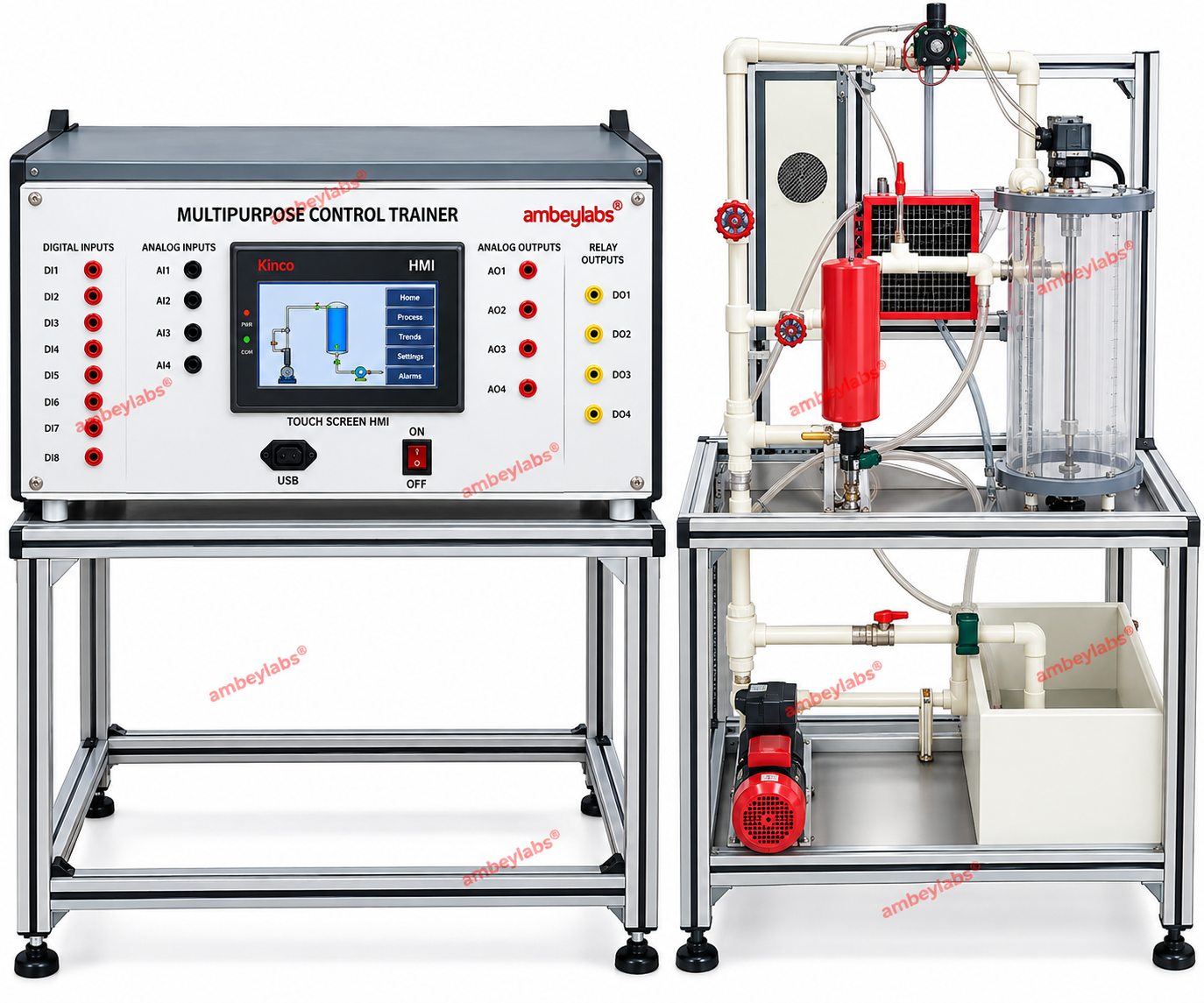
The AL-E187E
Level / Flow / Pressure / Temperature Control Bench with Cascade
is a comprehensive process-control training system designed for practical study
of PID control, flow control, level control, pressure control,
temperature control, ratio control, cascade control and multi-loop regulation.
The system consists of a transparent process tank,
heating and cooling circuits, pumps, sensors, proportional valves, flow
measurement, pressure and temperature measurement, and computer-based
supervision and data-acquisition software. It is suitable for laboratory
training in process instrumentation, industrial automation, control
engineering and mechatronics.
2. Educational Operations
The trainer shall support practical implementation and
demonstration of:
- PID regulation — Proportional,
Integral and Derivative control
- Flow
regulation
- Level
regulation
- Pressure
regulation
- Temperature
regulation
- Ratio
regulation
- Cascade
regulation
- Master
Level / Slave Flow control
- Multi-loop
regulation
- Interactive
regulation loops
3. Technical Specifications
|
Parameter |
Specification |
|
Model |
AL-E187E |
|
Equipment |
Level / Flow / Pressure / Temperature
Control Bench with Cascade |
|
Construction |
Table-top / bench-mounted process-control
system |
|
Process Tank |
Transparent process tank |
|
Control Modes |
PID, Ratio, Cascade, Multi-loop and
Interactive |
|
Level Control |
Provided |
|
Flow Control |
Provided |
|
Pressure Control |
Provided |
|
Temperature Control |
Provided |
|
Master-Slave Control |
Master Level / Slave Flow |
|
Supervision |
Computer-based supervision and data
acquisition |
|
Power Supply |
220 V AC, 50 Hz |
|
Overall Operative Dimensions |
Approx. 800 × 1000 × 450 mm |
|
Approx. Weight |
40 kg |
|
Documentation |
User and practical-work manuals, paper and
digital versions |
4.
Transparent Process Tank
The main process tank shall be transparent and equipped
with:
- Coil heat
exchanger
- Agitator
- Vent valve
- Pressure
sensor with 0–10 V DC output
- Level sensor with 0–10 V DC output
- PRT
temperature sensor with 0–10 V
DC output
- Drain valve
- Process
connections for heating and cooling circuits
5.
Heating Loop
The heating circuit shall include:
- Heating tank
- Electrical
heating resistor
- Heating control with 0–10 V DC control/output
- Low-level safety protection using
float switch
- Temperature
sensor
- Circulation
pump with 0–10 V DC control/output
- Heat
exchanger / temperature-sensor return arrangement
- Temperature measurement at tank
return
- Flow-rate
sensor in the heating loop
- Over-temperature
safety system
- Suitable
piping and process connections
6.
Cooling Loop
The cooling circuit shall include:
- Cooling radiator
- Cooling fan
- Cooling tank with low-level
safety
- Circulation
pump with 0–10 V DC control/output
- PRT temperature sensor at
cooling-radiator inlet
- PRT temperature sensor at
cooling-radiator outlet
- Both
temperature sensors with 0–10 V
DC output
- Flow sensor
with 0–10 V DC output
- Proportional control valve with 0–10 V DC control/output
- Regulation
bypass valve
- Suitable piping, hoses and
process connections
7.
Control & Regulation Functions
PID
Control
The system shall permit independent adjustment of:
- Proportional
gain
- Integral
gain
- Derivative
gain
The PID system shall be usable for level, flow, pressure
and temperature control experiments.
Ratio
Control
The system shall support ratio regulation between
selected process variables, allowing students to study the relationship between
master and slave process signals.
Cascade
Control
The trainer shall support cascade
regulation with Master Level / Slave Flow Rate, allowing
practical study of master-slave control loops.
Multi-Loop
Control
The system shall support simultaneous operation and study
of multiple interacting control loops.
8.
Supervision & Data Acquisition Software
The system shall be supplied with supervision and data-acquisition software having a graphical
interface.
The software shall provide:
- Real-time process monitoring
- Real-time curve display
- Measurement
and recording of process variables
- Configuration
of control loops
- Virtual
instruments
- Signal
simulation
- Mathematical and control blocks
- PID
parameter adjustment
- Process-response
analysis
- Data
acquisition and visualization
9.
Simulated Signal Blocks
The software shall provide signal-generation functions
including:
Signal
Generator
- Sinusoidal
waveform
- Square waveform
- Sawtooth waveform
- Variable
frequency
- Variable
amplitude
- Variable
offset
DC
Level
- Fully variable DC level
10.
Virtual Instruments
The software shall include the following virtual
instruments:
- Digital
measuring device
- Bar graph
- Analog measuring device
- Oscilloscope
- Chart
recorder
11.
Regulation Blocks
The software shall provide configurable control blocks:
|
Block |
Function |
|
Proportional Gain |
Fully
variable |
|
Integral Gain |
Fully
variable |
|
Derivative Gain |
Fully
variable |
|
Phase Advance |
Adjustable
control function |
12.
Simulation Blocks
The software shall include process simulation blocks for:
- Integer
- First-order system
- Double
integrator
- Second-order system
- First-order
system with integrator
- Second-order under-damped system
13.
Additional Functional Blocks
The software shall provide:
- Gain
- Voltage-to-frequency
converter
- Delay
- Discrete transfer function
- Saturation
- Summing junction
ü
Three inputs
- Multiplier
ü
Three inputs
- Switch
- Relay
14.
Fuzzy Logic Blocks
The software shall include fuzzy-logic functions for
advanced control studies:
- Fuzzy potentiometer
- Fuzzification
- Defuzzification
- Fuzzy
multiplexer
- Fuzzy demultiplexer
- Fuzzy AND
- Fuzzy OR
- Fuzzy NOT
- Fuzzy lookup/table function
- Combined fuzzy measuring device
- Simple fuzzy measuring device
15.
Safety Features
The system shall incorporate suitable safety provisions
including:
- Low-level safety for heating tank
- Low-level
safety for cooling tank
- Over-temperature
protection
- Controlled
heating operation
- Process
drain arrangement
- Central
electrical protection
- Safe process
connections
- Properly
enclosed electrical/control sections
16.
Mechanical Construction
- Robust laboratory bench/table-top
construction.
- Transparent process vessels for
easy observation of process operation.
- Industrial-grade piping and
fittings.
- Clearly
identified process components.
- Easily
accessible sensors, valves and measurement points.
- Suitable arrangement for repeated
student experiments.
- Compact construction suitable for
laboratory installation.
17.
Power Supply
220 V AC, 50 Hz
The electrical system shall include appropriate
protection and switching provisions for the trainer, pumps, heater, control
system and associated instrumentation.
18.
Dimensions & Weight
|
Parameter |
Specification |
|
Operative Part Dimensions |
Approx.
800 × 1000 × 450 mm |
|
Weight |
Approx.
40 kg |
19.
Documentation & Training Material
The equipment shall be supplied with:
- User Manual
— Paper Version
- User Manual
— Digital Version
- Practical
Work / Experiment Manual — Paper
Version
- Practical
Work / Experiment Manual — Digital
Version
- Software
installation and operating documentation
- Control-system
experiment documentation
- Necessary
software for supervision, data acquisition and simulation
20. Recommended Experiments
The trainer is suitable for experiments such as:
1.
Study of PID control characteristics.
2. Level
control using PID controller.
3. Flow
control using PID controller.
4. Pressure
control.
5. Temperature
control using heating and cooling loops.
6. Study
of proportional control.
7. Study
of integral control.
8. Study
of derivative control.
9. Ratio-control
experiment.
10. Cascade
control — master level/slave flow.
11. Multi-loop
process control.
12. Interactive
control loops.
13. Study
of process response using real-time graphs.
14. Study
of first- and second-order systems.
15. Study
of fuzzy-logic control.
16.
Simulation and analysis of control-system
response.