
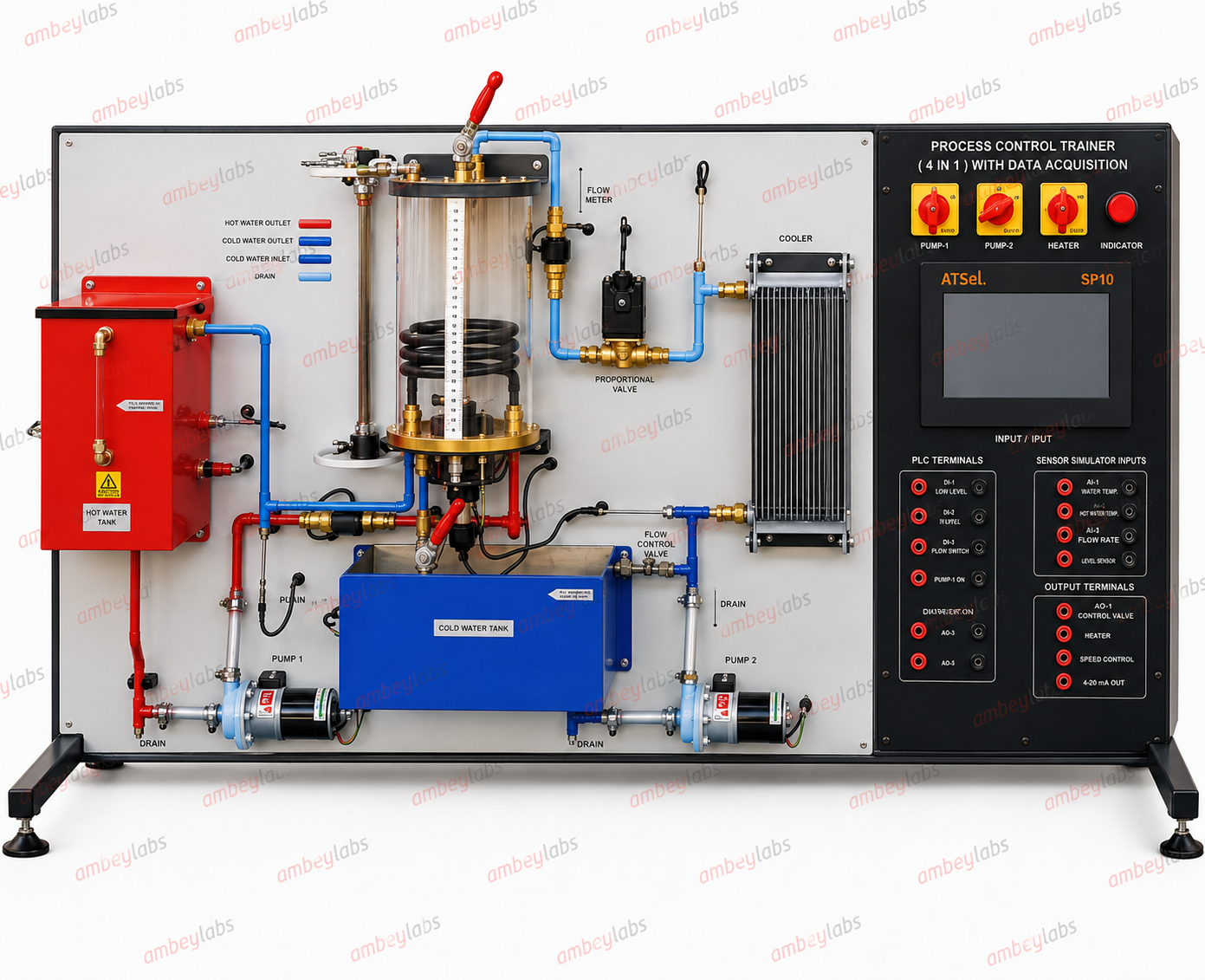
AL-E187H MULTI PROCESS CONTROL TRAINER
Project Information
- Category: MECHANICAL ENGINEERING
- Sub Category: PROCESS CONTROL TRAINER
- Model Number: AL-E187H
Description
AL-E187H MULTI PROCESS CONTROL TRAINER
MULTI PROCESS
TRAINER
DESCRIPTION
Process
Trainer is an educational package that mimics industrial process engineering.
The fully integrated, self-contained teaching apparatus gives a comprehensive
range of process control experiments, from basic to advanced.
Using
water as the working fluid, the equipment allows safe, practical experiments on
control of flow, liquid level, temperature and pressure. Students can study
each of these separately or in combinations.
The
experiment module includes all the essential parts to allow students to create
process control systems. The main part is the process vessel, with a stirrer, a
temperature sensor, level and pressure sensors, a heat exchanger and vent
valve. It also includes two loops, linked by the heat exchanger in the process
vessel. One loop is the heating loop with pump, heater tank and heater. The
other loop is a process and cooling loop with pump, cooler, fan, valves and
reservoir.
The
control module links to the experiment module to provide access to the
connections of each part on the experiment module. It includes a clear mimic
diagram with switches and controls to allow manual control of pump speed,
cooler-fan speed, heater power and stirrer. It also includes sockets and a
built-in computer interface. This allows the user to link each part of the
experiment module to a suitable computer (not included) for remote control and
data acquisition.
Clear process vessel with:
•
Heat exchanger coil
•
Stirrer
•
Vent valve
•
Pressure transmitter
•
Level transmitter
•
Temperature transmitter
•
Drain valve
Heating loop with:
•
Heater tank with heater
•
Low level float switch
•
Temperature transmitter
•
Circulation pump
•
Heat exchanger output/tank return temperature transmitter
•
Heater loop flow rate transmitter
•
Over-temperature safety device
•
Cooling radiator and fan
•
Reservoir (with low-water level switch)
•
Circulation pump
•
Temperature transmitter (at inlet to the cooling radiator)
•
Temperature transmitter (at outlet of the cooling radiator)
•
Flow transmitter
•
Proportional valve
•
Process loop bypass valve
DATA ACQUISITION UNIT
A
Data Acquisition (DAQ) Unit for a 4-in-1 Process Control Trainer
(covering flow, level, pressure, and temperature loops) functions as the
hardware interface between the trainer's physical transmitters/actuators and a
PC running SCADA/PID software.
- Number
of Channels: Minimum 4 channels
(Differential/Single-ended)
- Resolution: 16-bit
to 24-bit delta-sigma Analog-to-Digital Converter (ADC) for accurate
process measurement.
- Signal
Ranges:
- Current:
4 to 20 mA (Standard industrial instrumentation loop).
- Voltage:
0 to 5 VDC, 0 to 10 VDC, or 0 to 2.5 V.
- Sampling
Rate: 10 Hz to 1 kHz per channel (Sufficiently fast for thermal and
hydraulic processing loops).
Analog Output (AO) Specifications
Used
to output control signals to actuators, such as a motorized proportioning
valve, a thyristor circuit for a heater, and a variable speed pump.
- Number
of Channels: 2 channels (minimum).
- Resolution: 12-bit
to 16-bit Digital-to-Analog Converter (DAC).
- Signal
Ranges:4 to 20 mA and 0 to 10 VDC (for variable
frequency drives , valves and actuators)
Digital
Input / Output (DI/DO)
- Channels:Typically,
4 to 8 Channels (both DI and DO).
- Digital
Inputs: Used for reading limit switches, proximity sensors, pulse-type
flow meters, and fault alarms.
- Digital
Outputs: 24VDC or Relay/SSR outputs to drive ON/OFF solenoid valves,
stirring motors, and heaters.
Connectivity
·
PC Interface:USB port
·
Termination: Heavy-duty,
industrial-grade 4 mm shrouded banana sockets
·
Power Supply: Operating
power typically drawn from 230V AC mainsand an internal regulated 24V DC
supply.
·
Software Support: Bundled with standard window-based PID/SCADA logging software
developed in NI LabVIEW)
Data sheet of PLC is attached for more details
LEARNING OUTCOME
- Proportional,
Integral and Derivative (PID) control
- Control
of flow
- Control
of level
- Control
of pressure
- Control
of temperature
- Multi-loop
control
- Interacting
control loops