

AL-E452 DC COMPOUND MOTOR (CUT SECTION MOTOR)
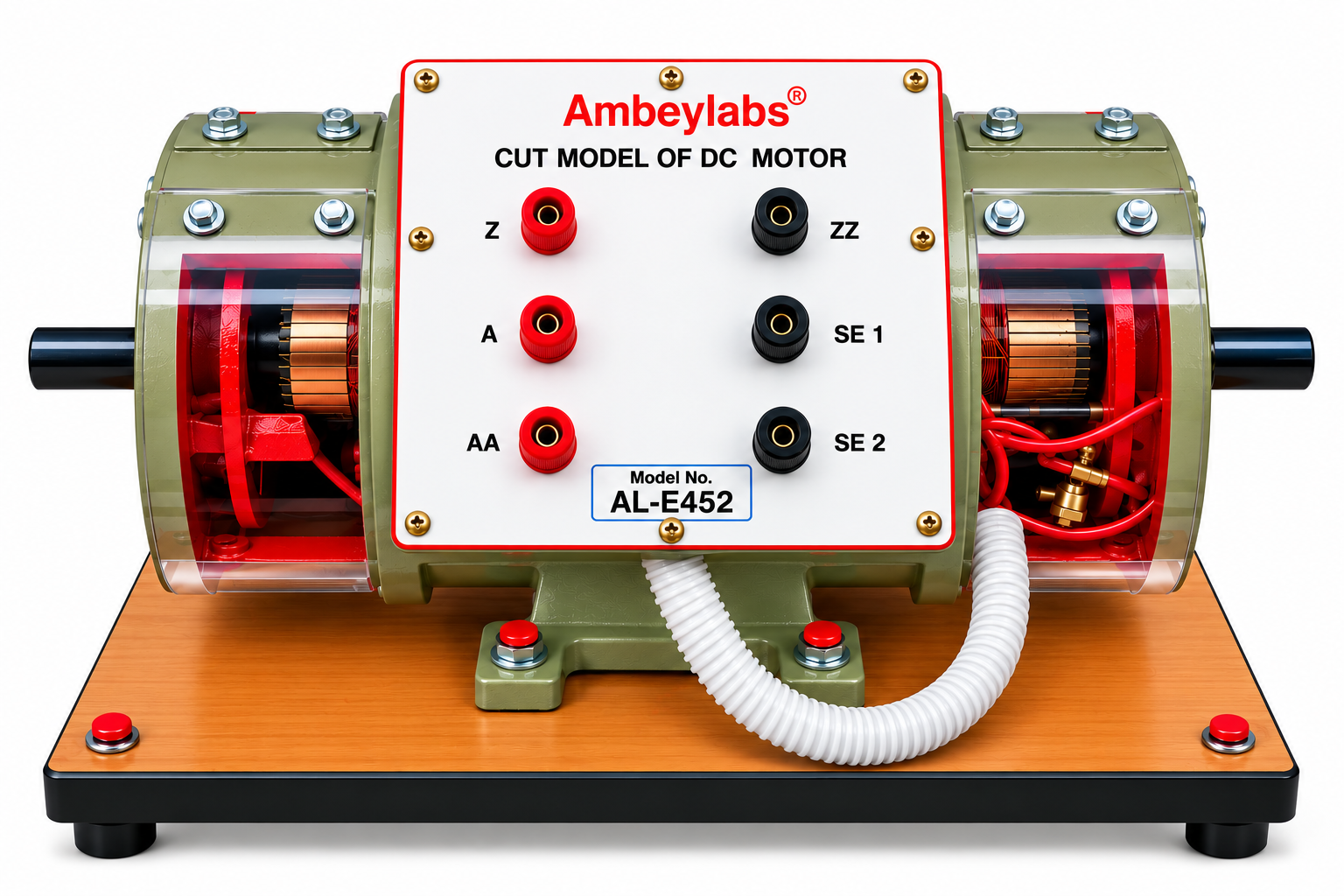
Project Information
- Category: ELECTRICAL ENGINEERING
- Sub Category: CUT SECTION MOTORS
- Model Number: AL-E452
Description
AL-E452 DC COMPOUND MOTOR (CUT
SECTION MOTOR)
Product Code: AL-E452
Product Category: Electrical Machines
Laboratory Training Equipment
-------------------------------------------------------------------------------------------------------------------------------------------
Application:
Study of DC compound motor construction, winding connections, operating
principles, and electrical machine components.
1.
Detailed Technical Specifications
|
S. No. |
Parameter |
Technical Specification |
|
1 |
Type of Machine |
DC Compound Motor |
|
2 |
Model Number |
AL-E452 |
|
3 |
Rated Power |
1 HP (0.75 kW) |
|
4 |
Operating Voltage |
230 V DC |
|
5 |
Rated Speed |
1440 RPM, as specified |
|
6 |
Motor Construction |
Cut-section type |
|
7 |
Field System |
Compound field winding comprising
shunt and series field windings |
|
8 |
Armature |
DC armature with winding and
commutator assembly |
|
9 |
Terminal Connections |
5 BTI 15 terminals, as specified |
|
10 |
Shaft Arrangement |
Single shaft |
|
11 |
Frame Size |
132 |
|
12 |
Mounting Arrangement |
B3 – Foot-mounted |
|
13 |
Yoke |
Solid yoke extension |
|
14 |
Brush Assembly |
Brush and commutator arrangement for
electrical contact |
|
15 |
Enclosure Designation |
SPDP, as specified |
|
16 |
Protection Rating |
IP23, subject to manufacturer
confirmation |
|
17 |
Cooling Designation |
IC01, subject to manufacturer
confirmation |
|
18 |
Cutaway Housing |
Transparent viewing sections for
internal component observation |
|
19 |
Mounting Base |
Rigid metal base |
|
20 |
Intended Use |
Educational demonstration and
laboratory experiments |
2.
Constructional Features
- Yoke: Provides mechanical support and
serves as the magnetic return path.
- Main poles and field windings:
Establish the magnetic field required for motor operation.
- Series field winding: Connected in
series with the armature circuit to provide a load-dependent magnetic
field component.
- Shunt field winding: Connected in
parallel with the supply or armature circuit according to the selected
compound connection.
- Armature core: Laminated magnetic core
designed to reduce eddy-current losses.
- Armature winding: Carries current and
interacts with the magnetic field to develop torque.
- Commutator: Maintains unidirectional
torque by reversing current in the appropriate armature conductors.
- Brush assembly: Provides electrical
contact between the stationary external circuit and rotating commutator.
- Single shaft: Provides the mechanical
output arrangement.
- Cut-section construction: Allows
students to observe internal motor components without dismantling the
complete machine.
- Metal mounting base: Provides
stability during laboratory demonstrations.
3.
Experiments and Learning Objectives
The AL-E452 DC Compound Motor is
suitable for the following laboratory activities:
- Study of DC compound motor
construction and operation.
- Identification of the yoke, poles,
armature, commutator, and brushes.
- Study of series and shunt field
winding arrangements.
- Understanding cumulative and
differential compounding.
- Study of the torque characteristics of
a DC compound motor.
- Observation of internal electrical and
mechanical components.
- Study of the relationship between
armature current, field flux, torque, and speed.
- Comparison of DC shunt, series, and
compound motor characteristics.
- Study of terminal identification and
winding connection diagrams.
4. Working
Principle
A DC compound motor combines series and
shunt field windings. When DC power is applied, the field windings establish
magnetic flux, while current flowing through the armature conductors produces
electromagnetic torque.
The series field flux varies with
armature current, while the shunt field provides a comparatively stable flux.
Depending on the polarity and connection of the two field windings, the motor
can operate with cumulative or differential compounding.
The developed torque is approximately
expressed as:
5.
Educational Benefits
- Provides a clear visual understanding
of DC compound motor construction.
- Helps students identify individual
motor components and their functions.
- Supports practical demonstrations of
series and shunt field connections.
- Facilitates comparison of different DC
motor characteristics.
- Suitable for electrical engineering
laboratories, polytechnics, engineering colleges, and technical training
institutes.
6. General
Requirements
- Robust construction suitable for
repeated educational use.
- Clearly visible internal components
through cutaway sections.
- Clearly identifiable terminals for
field and armature connections.
- Secure mounting on a rigid metal base.
- Suitable for supervised laboratory
demonstrations.
- Appropriate electrical protection and
safe connection arrangements for 230 V DC operation.
Technical verification note: The
specified 230 V DC supply, 1 HP rating, 1440 RPM speed, and five-terminal
arrangement should be verified against the manufacturer's nameplate and wiring
diagram. The designations SPDP, 1P23, and 1C01 have been retained or
interpreted as supplied; confirm the exact enclosure, IP protection, and
cooling classifications before submitting this specification as part of a
formal tender.