
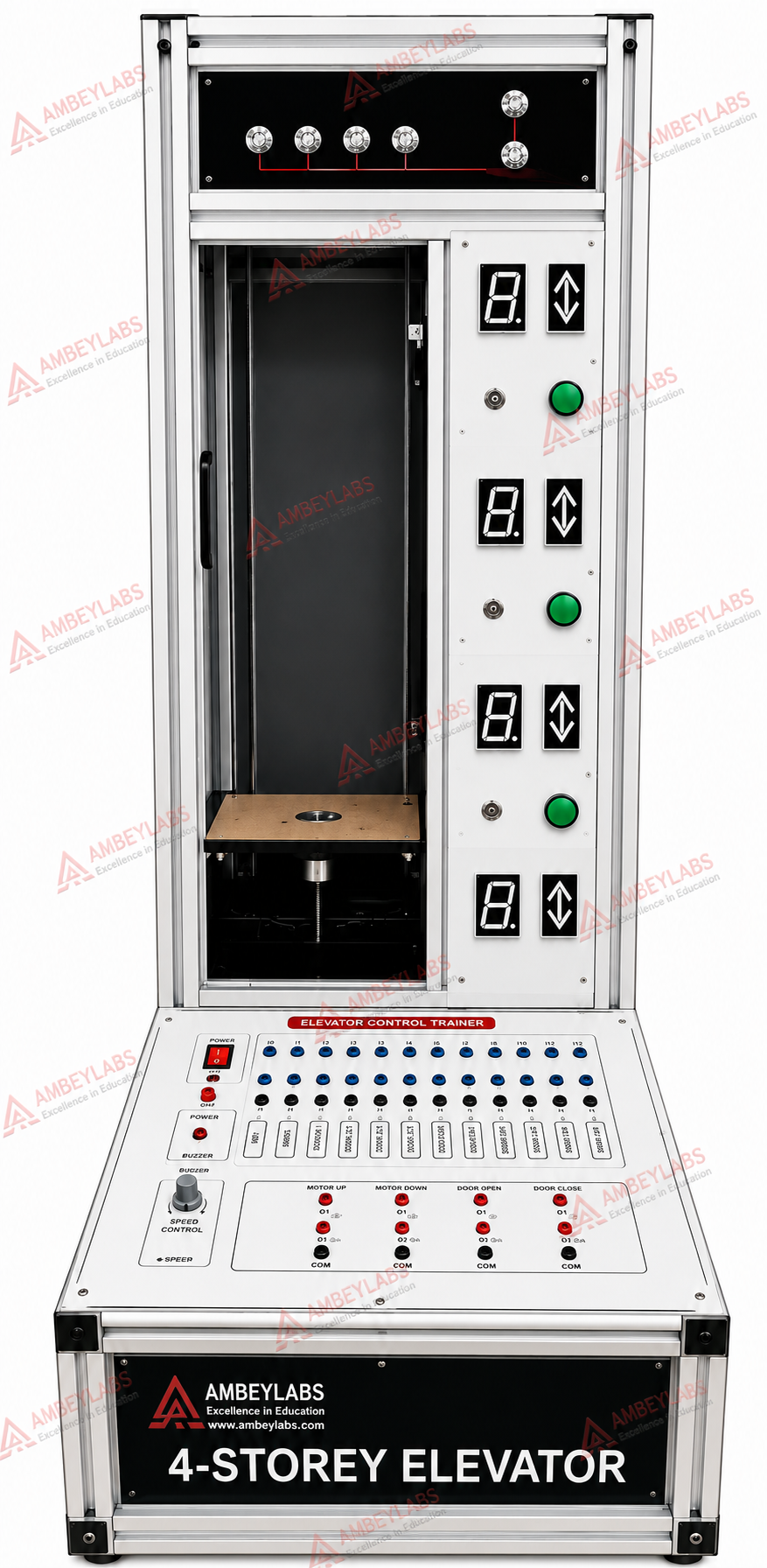
AL-E601B ELEVATOR LIFT CONTROL MODULE BY PLC TRAINER -4 STOREY
Project Information
- Category: ROBOTICS AND MECHATRONICS
- Sub Category: PLC TRAINER
- Model Number: AL-E601B
Description
AL-E601B
ELEVATOR LIFT CONTROL MODULE BY PLC TRAINER -4 STOREY
DETAILED TECHNICAL
SPECIFICATION
AL-E601B 4-STOREY
ELEVATOR LIFT CONTROL MODULE FOR PLC TRAINER
Product Code: AL-E601B
Product Name: 4-Storey
Elevator Lift Control Module for PLC Trainer
Category: PLC Trainers
/ Industrial Automation Trainers
1. Product Overview
The AL-E601B
4-Storey Elevator Lift Control Module is an advanced industrial
PLC-based training system designed to simulate the operation of a modern
four-storey elevator. The trainer enables students to develop, test and
troubleshoot PLC programs used in elevator automation systems.
The trainer
accurately replicates the mechanical and electrical operation of an industrial
elevator using a geared DC motor, belt and counterweight mechanism, motorized
door, limit switches, digital and analog I/O interfaces, speed control, floor
indication system, and programmable PLC interface.
The system is
suitable for practical training in PLC programming, industrial automation,
mechatronics, process control, sequential logic, and motion control.
2. Educational Objectives
The trainer enables students to:
- Study elevator automation systems
- Learn PLC programming using
Ladder Logic
- Understand sequential control
techniques
- Implement elevator call
scheduling
- Program floor selection logic
- Study motor control applications
- Understand speed control systems
- Learn sensor interfacing
- Implement safety interlocking
- Perform industrial
troubleshooting
3. Working Principle
The elevator trainer simulates the operation of a Ground + 3 Floor elevator
controlled through a PLC.
When a floor
call button is pressed:
- The PLC receives the request.
- Elevator direction is determined.
- Motor starts through the power
amplifier.
- Elevator travels to the desired
floor.
- Position sensors detect arrival.
- Mechanical brake locks the car.
- Motorized door operation is
simulated.
- Floor position and travel
direction are displayed.
- Internal and external requests
are processed according to programmed priority.
4. Mechanical Construction
The trainer is built using a heavy-duty aluminium extruded frame
and incorporates a realistic elevator mechanism.
Construction Features
- Heavy-duty Aluminium Extruded
Structure
- Powder Coated Metal Cabinet
- Transparent Polycarbonate Side
Panels
- Transparent Rear Panel
- Real Elevator Mechanical
Construction
- Belt Driven Elevator Mechanism
- Counterweight System
- Chain Drive Arrangement
- Wire Rope Mechanism
- Geared DC Motor Drive
- Four Castor Wheels for Easy
Movement
5. Elevator System Specifications
- Elevator Type: PLC Controlled
Industrial Trainer
- Number of Floors: Ground + 3
Floors
- Total Floors Simulated: 4
- Drive System: Belt Drive
- Counterweight System: Yes
- Geared Motor Drive
- Chain Transmission
- Wire Rope Arrangement
- Motorized Elevator Door
- Internal Cabin Lighting
- Arrival Siren
- Mechanical Brake System
- Closed Loop Speed Control
6. PLC Interface
The trainer is compatible with industrial PLC systems.
PLC Interface Features
- Universal PLC Compatibility
- Digital Inputs
- Digital Outputs
- Analog Inputs
- Analog Outputs
- Ladder Programming
- External Controller Interface
- PLC Logic Development
- Industrial Automation Experiments
7. Electrical Specifications
|
Parameter |
Specification |
|
Operating Logic |
24 V DC |
|
Digital Inputs |
20 |
|
Digital Outputs |
16 |
|
Analog Inputs |
3 (0–10 V DC) |
|
Analog Outputs |
4 (0–10 V) |
|
PLC Interface |
Universal |
|
External Pull-up Voltage |
3–24 V DC |
8. Motion Control System
The elevator incorporates an industrial motion control system
consisting of:
- Geared DC Motor
- Motor Winder
- Fully Protected Power Amplifier
- Closed Loop Speed Control
- Counterweight
- Mechanical Brake
- Vertical Guide System
- Position Sensors
- Travel Limit Switches
9. Speed Control
The trainer supports multiple elevator speeds:
- 100% Speed
- 60% Speed
- 30% Speed
Travel time
from Ground Floor to Top Floor:
Approximately
7 Seconds at full
speed.
10. Control Panel Features
The control panel includes:
Floor Controls
- Ground Floor Call Button
- First Floor Call Button
- Second Floor Call Button
- Third Floor Call Button
Elevator Controls
- Up Command
- Down Command
- Door Open
- Door Close
- Manual Drive Switch
- Emergency Controls
Display
- Floor Position Display
- Direction Display
- Floor Indication Lamps
- Elevator Status Indicators
- Internal Lighting Indicator
- Arrival Siren
11. Sensors and Safety Devices
- Mechanical Limit Switches
- Vertical Limit Switches
- Position Sensors
- Door Limit Switches
- Mechanical Brake
- Counterweight
- Motor Protection
- Jam Protection
- Overload Protection
- Power Amplifier Protection
12. Wiring Interface
The trainer provides:
- 4 mm Safety Socket Interface
- Patch Cord Wiring
- Plug and Socket Connections
- PLC Interface Connectors
- Graphically Printed Wiring
Symbols
13. Software Features
- PLC Programming Support
- Sample PLC Programs
- Practical Exercises
- Ladder Logic Development
- Software Package Included
14. Practical Experiments
Students can perform experiments on:
- Elevator PLC Programming
- Floor Selection Logic
- Up/Down Motion Control
- Speed Control
- Closed Loop Control
- Motor Drive Programming
- Counterweight Operation
- Mechanical Brake Control
- Door Control
- Internal Cabin Requests
- External Floor Requests
- Priority Scheduling
- Digital Input Programming
- Digital Output Programming
- Analog Input Applications
- Analog Output Applications
- Fault Detection
- Fault Simulation
- Industrial Troubleshooting
15. Fault Simulation
The trainer supports:
- PLC Fault Simulation
- Sensor Fault Simulation
- Limit Switch Fault
- Motor Fault
- Door Fault
- Communication Fault
- DIP Switch Based Fault Selection
16. Technical Features
- Transparent Polycarbonate
Enclosure
- Realistic Elevator Construction
- Industrial Components
- Closed Loop Speed Control
- Mechanical Brake
- Counterweight Mechanism
- PLC Interface
- Analog & Digital I/O
- Manual Drive Mode
- Sample PLC Programs
- User Friendly Connections
17. Dimensions
|
Parameter |
Specification |
|
Width |
520 mm |
|
Depth |
480 mm |
|
Height |
1110 mm |
Packaged
Dimensions.
18. Weight
|
Parameter |
Value |
|
Net Weight |
16 kg |
|
Gross Weight |
21 kg |
19. Scope of Supply
- AL-E601B 4-Storey Elevator Lift
Trainer
- Elevator Mechanical Assembly
- Geared DC Motor
- Counterweight System
- Belt Drive Mechanism
- Wire Rope Arrangement
- Motorized Door
- Floor Indication System
- PLC Interface
- Analog and Digital Interface
- User Manual (Printed)
- User Manual (Digital)
- Practical Experiment Manual
- PLC Software Package
Optional Accessory:
- Computer System (Available on
Demand)
20. Applications
- PLC Programming Laboratory
- Industrial Automation Laboratory
- Mechatronics Laboratory
- Electrical Engineering Laboratory
- Electronics Engineering
Laboratory
- Vocational Training Institutes
- Polytechnic Colleges
- Engineering Colleges
- Skill Development Centres
- Industrial Training Organisations
21. Learning Outcomes
After completing the practical exercises, students will be able
to:
- Develop PLC programs for elevator
automation.
- Interface sensors and actuators
with PLC systems.
- Implement multi-floor elevator
control logic.
- Program speed and direction
control.
- Design sequential and
interlocking logic.
- Analyze elevator safety systems.
- Troubleshoot industrial automation
systems.
- Understand real-world elevator
operation and maintenance.
Salient Features
- PLC-based 4-storey elevator
simulation
- Realistic mechanical construction
with counterweight
- Belt-driven elevator mechanism
- Motorized door with door control
simulation
- Closed-loop speed control
- Mechanical brake with safety
protection
- Transparent polycarbonate
enclosure
- 20 digital inputs and 16 digital
outputs
- 3 analog inputs and 4 analog
outputs
- Multiple speed selection (100%,
60%, 30%)
- Manual drive and fault simulation
- Industrial-grade PLC interface
- Educational software and sample
PLC programs included
- Suitable for advanced PLC,
mechatronics, and industrial automation laboratories.